
When Do Border Collies Stop Growing? Height vs. Full Size
When Do Border Collies Stop Growing? (Height vs. Full Size)
Most Border Collies reach their full height around 12 months old, then keep filling out in the chest and muscle until somewhere between 15 and 24 months. So there are really two finish lines, and owners tend to mix them up.

I get why. Around the one-year mark your dog looks finished. Legs, back, head, all in proportion. Then six months later you realize he’s wider through the ribs and heavier on the scale, and you wonder if you misjudged. You didn’t. When do border collies stop growing? Taller first, bulkier later, and a little different for every dog.
I’m not a vet. I’m an owner who’s watched a gangly pup turn into a lean adult, and I’ll hand you to the people with credentials wherever health is involved. Here’s the timeline, a rough size guide, and what to do (and not do) while the bones are still finishing.
When do Border Collies reach full height and full size?
Quick version, then the detail.
- Full height: about 12 months. Canine Journal’s growth chart lists a 12-month Border Collie at 19 to 22 inches, which is basically adult height already.
- Most of the bulk: also around 12 months. The same source says most Border Collies have the majority of their bulk by 12 months.
- Finishing touches: 15 to 18 months. That’s when the same page says they stop growing, though it adds that it isn’t unusual for dogs to keep filling out until two years old.
- Late bloomers: up to 24 months. Chest depth, shoulder muscle, and overall heft can still creep up.
The vet side agrees in spirit. VCA Animal Hospitals says large breeds usually finish growing at 12 to 18 months, and timing varies with other factors too. Border Collies are medium-sized, so in my experience they likely land toward the early end of that window — but that’s my read, not a VCA number. And “finish growing” and “finished filling out” aren’t the same thing, which is why a 14-month-old can still look a bit like a teenager in a borrowed suit.
Individual dogs vary. Some are done at 11 months. Some are still changing at 20.
How big do Border Collies get, and how does size change by age?
Here’s the part I have to be careful with, because size charts online disagree with each other. Even a single chart can contradict itself. The ranges below come from the Canine Journal growth chart, and they’re averages, not promises.
- Newborn: about 7 to 14 ounces.
- 3 months: roughly 10 to 13 lbs for males and 8 to 12 lbs for females.
- 6 months: about 20 to 25 lbs for males, 18 to 22 lbs for females, standing around 12 to 16 inches.
- 9 months: roughly 33 to 35 lbs for males, 26 to 30 lbs for females, around 16 to 19 inches.
- 12 months: about 35 to 45 lbs for males and 30 to 40 lbs for females, at 19 to 22 inches.
- 24 months: about 40 to 55 lbs for males and 30 to 45 lbs for females.
For the adult dog, VCA’s breed page lists Border Collies at 18 to 22 inches tall and 30 to 55 pounds. Sources differ a little on the exact numbers — the Canine Journal chart, for instance, breaks height out by sex rather than giving one band — so don’t treat any single figure as gospel. That’s a wide range, and it should be. A 30-pound dog and a 55-pound dog can both be perfectly normal Border Collies.
A few things shift where your dog lands:
- Sex. Males run bigger and heavier. Females usually top out a few inches and several pounds below.
- Lines. This is the big one. Working-line dogs bred for sheep tend to be leaner and often smaller. Show-line dogs can be stockier. If you know the parents, they’re your best crystal ball.
- Frame vs. fat. Two dogs can weigh the same and look nothing alike. A Border Collie with a visible waist and ribs you can feel (not see) is built right, whatever the number says.
My own pup was solidly average. Which is to say, he was at the bottom of one chart and the top of another, depending on which website I was frowning at.
What is actually happening between 6 and 12 months?
The legs and frame tend to go first.
The 6-to-12 month stretch is when height catches up. A 6-month-old is leggy and long, a bit goofy, mostly vertical. By 9 months he’s close to adult height but narrow, like a coat hanger with fur. Then the chest drops, the shoulders broaden, and the proportions even out.
Feeding is part of this, and I’ll stay in my lane. A growing dog eats a growing dog’s food, in portions that keep him lean, and your vet is the person to set amounts for your particular pup. I won’t pretend to give you a gram count. What I can say from experience: a chubby Border Collie puppy is not a healthy one. Extra weight on growing joints is a bad bet, so keep him trim and ask your vet to check his body condition at puppy visits.
If you want the full stage-by-stage walk from newborn to adolescent, I covered it in Border Collie puppy growth stages. This article is just about where it all stops.
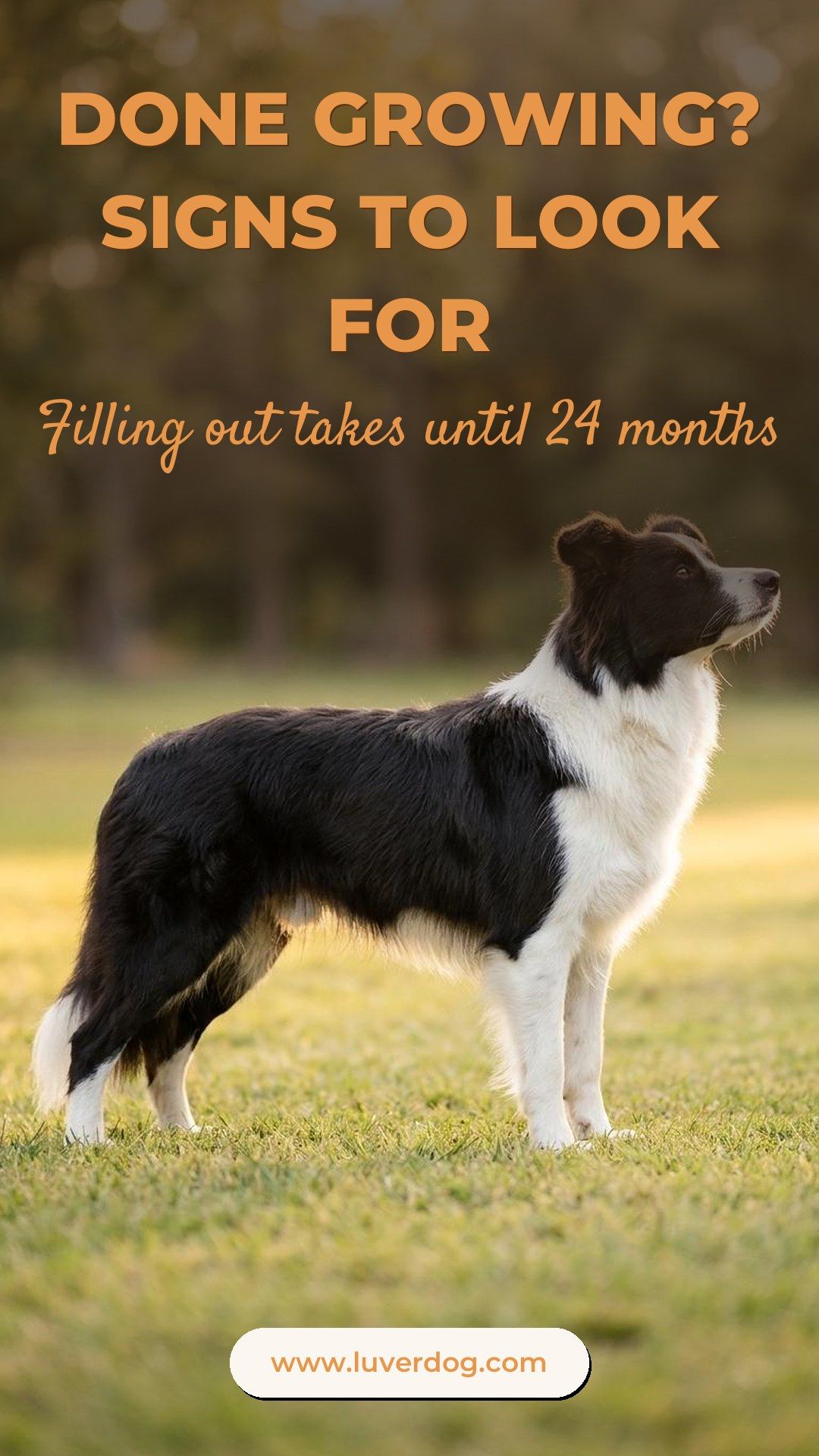
What are the signs your Border Collie is done growing?
There’s no bell. But there are clues.
- The scale stops moving much. Weigh him once a month. When the numbers flatten for two or three months running, you’re close.
- He stops outgrowing things. No new collar holes. The harness that fit last month still fits.
- The proportions settle. Legs, body, and head look like they belong to the same dog again. The gawky look is gone.
- The chest fills out. Deep through the ribs, tucked up at the waist. That athletic hourglass shape means the muscle has arrived.
- The coat changes. Many Border Collies get their full adult coat somewhere in this window. It’s a decent sign of maturity, though not a reliable clock.
- Appetite evens out. The bottomless-pit phase calms down, and the puppy-sized meals stop disappearing in four seconds. Mine got picky around a year, which I took personally.
Heads up on one thing. The only way to know for certain that growth plates have closed is an X-ray at the vet. Nothing you see at home can prove it. So treat the signs above as a good guess, and if you’re planning something that puts real stress on joints, ask your vet when it’s safe.
When do growth plates close, and why does it matter?
Growth plates are soft areas of developing bone near the ends of the long bones. Until they harden, the bones are still lengthening, and they’re more vulnerable to injury than adult bone.
VCA notes that a puppy’s plates are still forming at nine months and dogs can take on more varieties of exercise for longer periods once the plates fuse, and it says to check with your vet before starting any new exercise routine. The page gives the 12-to-18-month window for large breeds and adds that other factors besides breed size affect the timing; my own assumption is that a medium dog like a Border Collie lands somewhere in or just before that range, but only your vet can say. My own rule, separate from VCA: I hold off on anything high-impact — real jumping, hard agility — until a vet has cleared my dog for it.
This is where I slipped up with my own dog. At 10 months he looked like an adult. He acts like he could run all day. He asks for more. And you give it to him, because he’s built like an athlete.
But he isn’t done. The bones still are.
What I do with a pup under about 18 months, and what your vet may or may not agree with for your dog:
- Skip repetitive, hard-surface running. No jogging on pavement for miles.
- Hold off on the bike or long-distance running until the vet says the plates are done.
- Keep ball-chasing short. Sharp turns and hard stops are the problem, not the ball itself.
- Don’t let him launch off the couch or out of the truck bed over and over.
- Save serious agility jumps for later. Low-height foundation work is a conversation for your trainer and vet.
None of this means a dull life. It means shifting the energy into a different outlet.

What can you do with a Border Collie who’s done growing in height but not in maturity?
This is where the breed gets interesting. The body might be adult by 12 months, but the brain takes its sweet time. I wrote about that in when Border Collies calm down, and the short version is 2 to 3 years for most.
So you’ve got a physically grown dog with teenage decision-making. That’s a rough combination, and the answer isn’t more running. It’s more thinking.
- Scent games. Hide treats around the house. Ten minutes wears him out more than you’d expect.
- Training sessions. Short and sweet, five minutes, several times a day. Border Collies are wired for this, and it taxes the brain, not the joints.
- Puzzle feeders. A Kong Wobbler or a snuffle mat turns dinner into a job.
- Settle practice. A mat, a treat, and some patience. Teach him to do nothing. It’s the hardest trick in the book.
- Controlled sniff walks. On softer ground, unhurried, nose down.
One more thing. Growth spurts and adolescence can bring out herding nips and sudden pushiness. That’s normal for the breed and different from true aggression. If you’re not sure which you’re seeing, my piece on whether Border Collies are aggressive goes through the difference.
When is a Border Collie growing too fast, too slow, or not as expected?
Not every dog follows the chart. Most variation is harmless. But some of it deserves a professional look.
Talk to your vet if:
- Your pup is well above or well below the ranges for his age and sex, and the gap is getting bigger.
- He’s limping, stiff after rest, or reluctant to jump, run, or climb stairs.
- He’s gaining weight quickly and his waist is disappearing.
- His growth seems to have stalled well before 12 months.
- One leg looks different from the other, or he moves in a way that seems off.
- He yelps or flinches when you touch a joint.
I can’t tell you from here whether a lame pup has a sprain, a growth issue, or something else, and neither can a chart. That’s an exam and, sometimes, an X-ray. Don’t wait it out. Hip and elbow screening is also worth raising with your vet if you’re thinking about sport or working him hard later.
When can you stop worrying about growth?
Usually around 18 months, give or take, once your vet agrees he’s physically mature. Past that point, his body is an adult one, and your job shifts from “protect the growing” to “keep him fit and lean for the next decade.”
A few last things I’d tell a friend:
- Don’t panic if he’s smaller than the chart. Lines and parents matter more than a website.
- Don’t panic if he’s bigger, either, as long as he’s lean.
- Take photos every month from the same angle. The change is slow enough that you won’t see it day to day.
- Switching from puppy to adult food around the end of growth is a question for your vet, not a date on a calendar.
And enjoy the lanky phase. It’s gone before you know it.
Two finish lines, one patient owner
Border Collies hit their adult height around 12 months and keep building muscle and chest until 15 to 24 months, with the bones themselves finishing up somewhere in the 12 to 18 month range. Size depends on sex, lines, and the individual dog, so treat any chart as a rough map. Protect the joints a little longer than feels necessary, feed to keep him lean, and let your vet make the call on anything that looks off. Your dog will get there. The wait is the hard part.
References
- Canine Journal: Border Collie Growth Chart: Puppy Milestones & What To Expect
- VCA Animal Hospitals: Exercise for a 9-Month-Old Puppy
- VCA Animal Hospitals: Border Collie


Comments
Post a Comment