
Why Does My Dog Get Hiccups? (And When to Call a Vet)
Why Does My Dog Get Hiccups? (And When It’s Worth a Vet Call)
Picture a quiet evening. Your dog finishes dinner in about nine seconds flat, trots over to the couch, and then it starts: hic. hic. hic. Little jolts, right through the body. Why does my dog get hiccups, and should you be doing something about it?
Almost always, no. Dog hiccups are the same thing human hiccups are, a spasm in the diaphragm, and most bouts fade on their own in a few minutes. Gulped food, excitement, a chilly room, and being a puppy cover most cases. Now and then, though, hiccups hang around or travel with other symptoms, and that’s the part worth knowing.
I’ve lived with dogs for years, and the first time one of mine got a serious case of the hiccups I stood over her like a nervous parent, doing absolutely nothing useful. This guide covers what’s going on, why some dogs get them more, what you can do at home, and the signs that mean you should pick up the phone.
What actually causes dog hiccups?
A hiccup is a diaphragm spasm. The diaphragm is the big muscle under the lungs that drives every breath, and when it twitches, you get that sharp little jolt and the “hic” sound.
FirstVet describes hiccups as brief spasms of that muscle, and says one leading theory is swallowing too much air, often from eating or drinking fast, from excitement or stress, from hard exercise, or from breathing in irritants. Nobody has pinned down one single trigger. That’s the honest answer, and I’d rather give you that than a confident story.
Here are the usual suspects:
Eating too fast. The big one. Webvet calls fast eating the number one cause, and anyone who has watched a Lab inhale a bowl of kibble will believe it.
Gulping water. Especially after a run or a game of fetch, when your dog is panting and thirsty.
Excitement. Visitors, the leash coming off the hook, a squirrel. Fast breathing and swallowed air go together.
Getting cold. A sudden drop in temperature seems to set some dogs off. Webvet mentions sudden temperature changes, and FirstVet notes puppies may get hiccups when tired or cold.
Hard play. Rapid breathing again. My Border Collie would get a short run of hiccups after a very intense ball session, then be fine.
Irritants. Smoke, strong sprays, dust. Anything that makes the airway cranky.
One more idea you’ll see floating around: puppies may hiccup because it’s a leftover reflex from the womb, since hiccups have been observed in unborn animals. FirstVet mentions this as a theory. Cute, plausible, unproven.
Why do puppies get hiccups more than adult dogs?
They do. Ask anyone who has raised a litter.
Puppies eat like they’ve never seen food, play like tiny tornadoes, and then collapse in a heap, and every one of those habits is a hiccup trigger. FirstVet says puppies commonly get them daily, with episodes lasting only a few minutes. Their bodies are also still working out the machinery. Nothing there is a red flag on its own.
My experience matches that. The hiccups I remember most were from puppyhood, usually right after dinner, usually followed by a nap on somebody’s foot.
Adults can absolutely get them too. A grown dog with a hiccup bout after a big, fast meal is no more worrying than a puppy doing it. What changes is how I read the pattern. If an adult who rarely hiccups suddenly starts doing it all the time, I’d pay more attention than I would to a puppy having a daily after-dinner round.
How long do dog hiccups last?
Short. Think seconds to a few minutes. Webvet says a typical bout ends on its own, and that it becomes a concern when it lasts “more than about an hour.” FirstVet says episodes can run from minutes to hours when triggered, which is a wider range, so the sources don’t perfectly agree.
Here’s how I handle that disagreement. I don’t pick a magic number. I watch the dog.
- A few minutes, dog bright and playful: fine, move on.
- On and off through the day, several days in a row: mention it to your vet at the next visit.
- Going past an hour, or your dog seems bothered by them: call the clinic and ask.
Calling to ask is free (or close to it) and nobody at a vet’s office has ever rolled their eyes at me for it.
What can I do to stop my dog’s hiccups?
Honestly, not much, and that’s okay. There’s no proven trick. I’d skip the folklore, like scaring your dog or giving sugar, since nobody has shown that those help and a startled dog isn’t a happy dog. Here’s the gentle stuff that costs nothing:
- Let them settle. Quiet voice, a calm spot, a slow belly rub. Lowering the excitement often lowers the hiccups.
- Offer a little water. Small sips, not a gulp. Webvet suggests letting a dog sip rather than gulp, especially after exercise.
- Keep the room warm. If they got chilly, a blanket works.
- Slow things down. Walk, don’t wrestle, for a few minutes.
And that’s the list. If a particular dog gets stuck in a long bout, your vet is the one to ask about anything beyond that. I won’t suggest medicines or home remedies, because I’m not qualified to, and the wrong guess isn’t worth it.
How can I help prevent dog hiccups?
This is where your own habits do the most good. If hiccups usually come after meals, the fix is in the feeding routine.
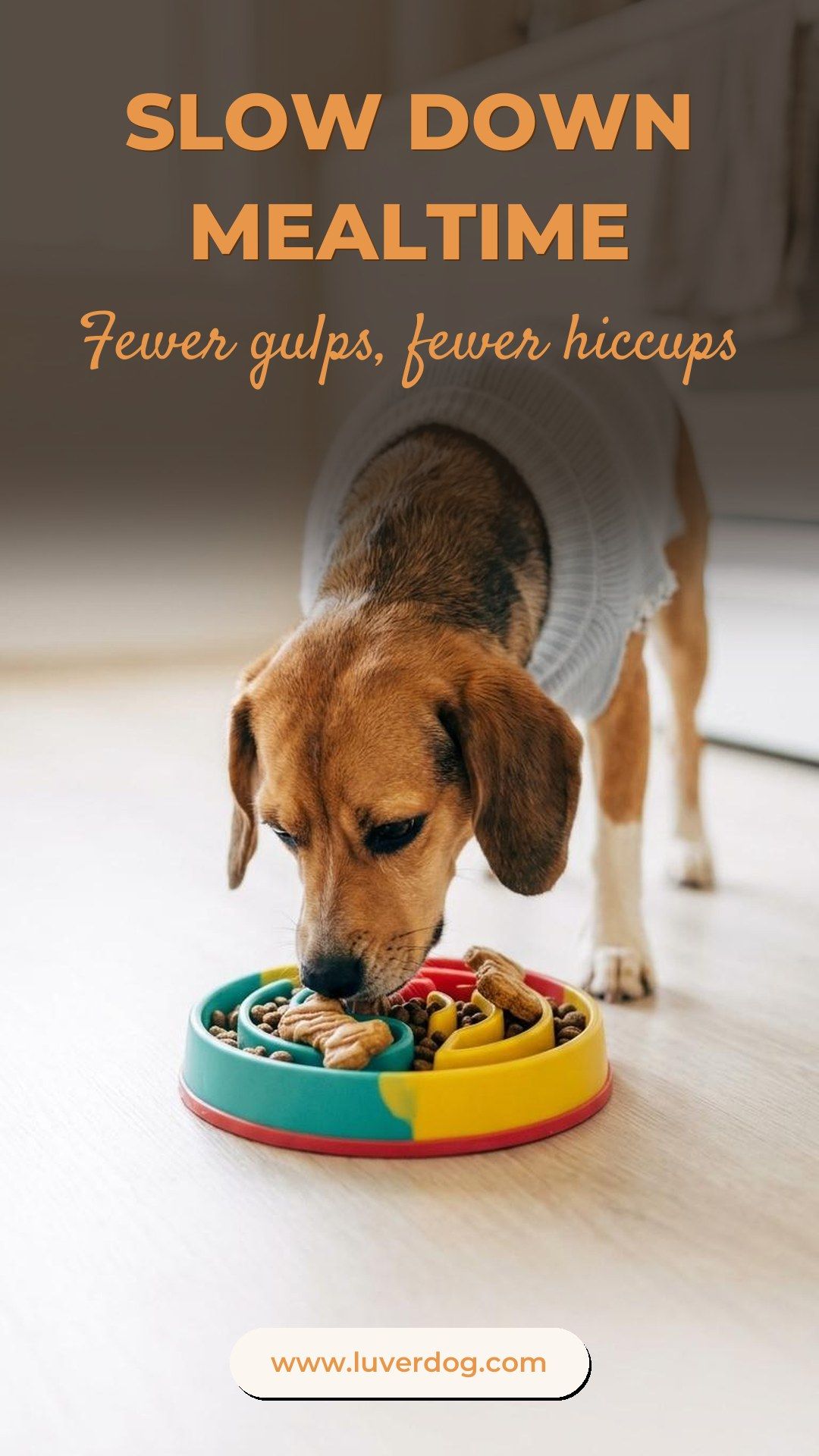
Slow down the eating. A slow-feeder bowl, a puzzle feeder, or a lick mat spreads dinner out. I’ve used a Kong Wobbler for one of my fast eaters and it turned a nine-second meal into a few minutes of rolling it around the kitchen.
Split meals up. Two or three smaller meals can calm the bolting for some dogs. Ask your vet what feeding schedule suits your dog, particularly for a puppy.
No wild play right after eating. I leave about an hour of quiet between a big meal and a game of fetch. It’s good for the hiccups and good for the stomach.
Water in small amounts after exercise. Let them cool down first, then drink.
Warm up after cold walks. Dry them off and skip the ice-cold bowl right after you come in from the snow.
Cut down the chaos at feeding time. If other dogs are crowding the bowl, feed them in separate spots. A stressed eater is a fast eater.
Slow eating pays off beyond hiccups. The AKC notes that fast eaters have five times the bloat risk of slow eaters, and bloat is a real emergency. I’ll come back to that, because it’s the serious thing hiding behind a “normal” habit.
If you want more on how a dog’s body sounds and moves in odd ways, I wrote about why dogs hack and gag and why dogs shake, and both include notes on when the cause isn’t harmless.
Are hiccups the same as reverse sneezing or coughing?
No, and mixing them up is common. I did it myself.
Hiccups are a rhythmic jolt, a little bounce of the chest or belly, usually with a quiet “hic.” Your dog is typically relaxed through the whole thing. They can lie down, eat, and carry on.
Coughing, gagging, wheezing, or a honking snort sound different. Those come from the airway, and the dog often looks like they’re working at it, with a stretched neck, a head thrust forward, or noisy breathing. If you can’t tell which one you’re seeing, take a short video on your phone. It’s the single most useful thing you can show a vet, because dogs never perform on the day of the appointment.
When are dog hiccups a sign of something wrong?
I’ll drop the jokes here, because this is the part that matters.
Hiccups alone are rarely an emergency. The trouble is what travels with them, or how long they stick around. Call your vet if you see:
- Hiccups that keep returning through the day, or lasting more than about an hour
- Coughing, wheezing, or noisy breathing
- Trouble breathing of any kind
- Vomiting, gagging, or repeated retching
- Drooling, hard swallowing, or sneezing
- Lethargy or weakness
Those signs come from the lists in FirstVet and Webvet. FirstVet adds that continuous hiccups can point to nerve function or breathing problems. That’s rare, and I can’t tell you which it would be for your dog. A vet can.
See a vet right away if
Hiccups plus a hard, swollen belly and unproductive retching (trying to vomit and nothing comes up) can mean bloat, which Webvet flags as a possible emergency. The AKC lists signs of bloat as an enlarged abdomen, retching, excess drooling, restlessness, and pain when the belly is touched, and says to call your vet or an emergency vet immediately if you suspect it. A dog can go into shock in only an hour or two.
Don’t wait to see if it passes. Go.
Trouble breathing, blue or pale gums, or a collapse are also emergency territory, whatever else is going on.
Do some dogs need a closer look?
A few groups are worth a bit more attention, mostly because they’re less able to shrug off a problem.
Very young puppies. Daily short hiccups are usual. A puppy who is also lethargic, coughing, or not nursing or eating well should see the vet, because small bodies get sick fast.
Deep-chested breeds. Great Danes, Weimaraners, and other large, deep-chested breeds carry a higher risk of bloat, and fast eating adds to it (the AKC puts a Great Dane’s risk at five to eight times higher). I’d be extra careful about slow feeding with any of them. Ask your vet about your own dog’s risk.
Senior dogs. A new habit of frequent hiccups in an older dog is the kind of change I’d mention at the next checkup, or sooner.
Dogs who have just started coughing. Hiccups with a new cough deserve a call. FirstVet and Webvet both list coughing as a warning sign.
Dogs with hiccups most days for weeks. Short bouts happen. A pattern that never lets up should be checked.
Could a change in routine be to blame?
Sometimes the cause is something small that you changed without noticing. A new food that’s extra tasty and gets wolfed down. A new puppy in the house who makes everyone eat faster. A heating system that’s off. A new scented spray.
When I’m puzzled, I keep a quick note on my phone: time of day, what happened just before, how long it lasted. After a week, the pattern jumps out. Mine usually pointed straight at the dinner bowl.
If your notes show no clear link and the hiccups are frequent, take them to the vet. I’d rather you arrive with a record than a guess.
The short version
Most dog hiccups come from eating or drinking too fast, being excited, getting cold, or just being a puppy, and they pass on their own. Slow-feeder bowls, smaller meals, and a calm pause after play handle the usual cases.
Call your vet if they last past an hour, keep coming back, or show up with coughing, trouble breathing, vomiting, or lethargy. A hard, swollen belly with retching is an emergency. Everything diagnostic, medical, or treatment-related is your vet’s job, not mine, and not the internet’s.
Watch your dog, trust your gut, and enjoy the cute ones.
References
- FirstVet: Why Does My Puppy Get Hiccups? (reviewed by Dr. Sheena Haney)
- Webvet: Dog Hiccups (medically reviewed by Dr. Pippa Elliott, BVMS MRCVS)
- American Kennel Club: Bloat in Dogs


Comments
Post a Comment